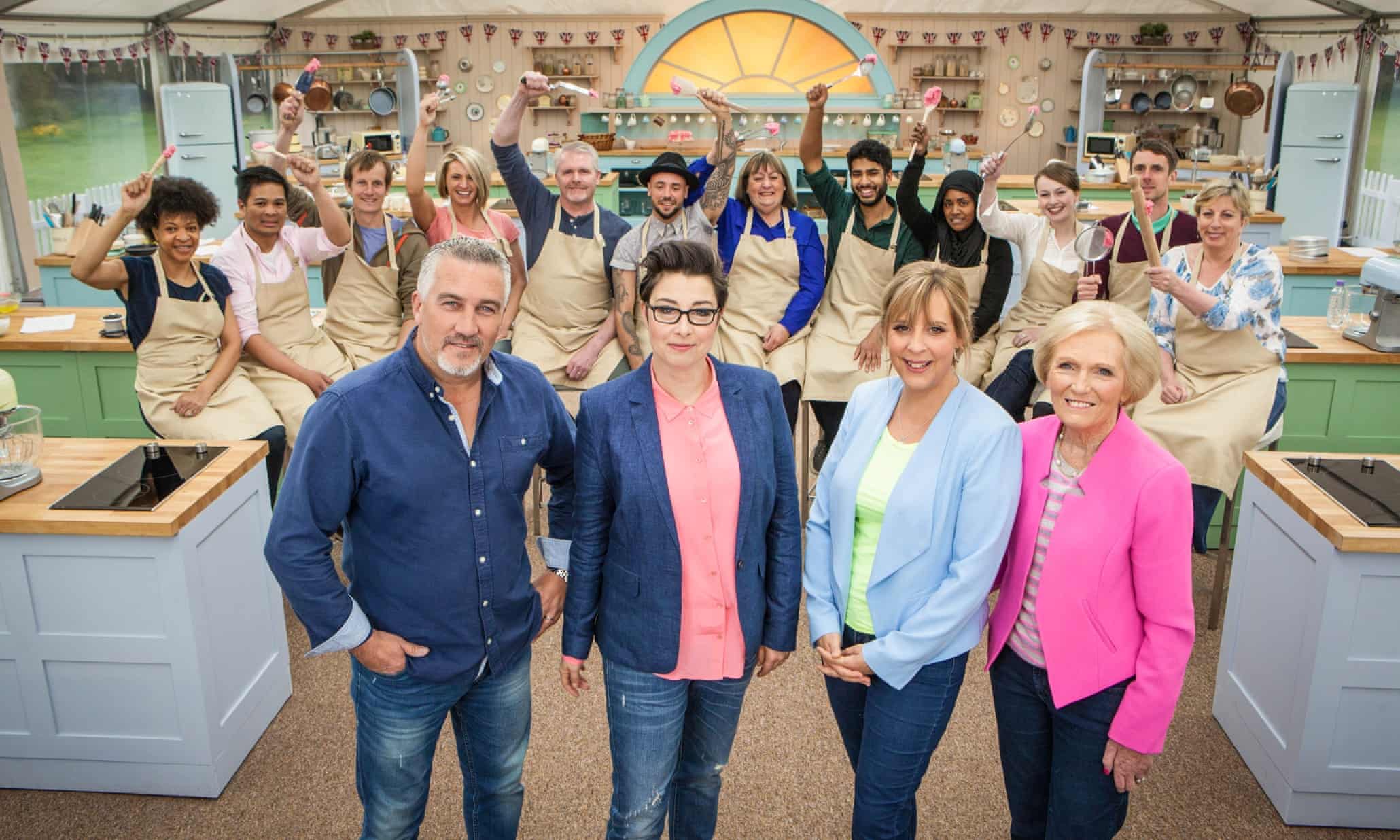
This week I’m forcing a leftist read of The Great British Baking Show, also known by its proper title, The Great British Bake Off (GBBO). If you haven’t watched it, you should: it might just be the most damn pleasant thing you’ve ever seen. It’s a competition-reality–style show where a number of skilled amateur bakers whip up imaginative (and oh so tempting) treats every week for judges Paul Hollywood and Mary Berry (the last names are for real; also, for those into the later seasons, Mary gets swapped out for Prue). Each week there is a theme (“bread,” “cake,” or “patisserie,” say), and the bakers have three tasks: a Signature (where they each make something of their choice according to a specified theme), a Technical (where they all have to follow the same recipe crafted by Paul or Mary), and a Showstopper (contestant choice on a theme, where presentation is just as important as taste). At the end of the episode, someone is crowned Star Baker (a title that confers nothing so much as glory--à la "Employee of the Month"). At the end of each episode--tension mounting, the strings leaping up a few octaves--someone is sent home. The field is ultimately pared down to three, and one baker is crowned champion.
My description above doesn’t really suffice to convey the show’s pleasantness. It takes place in a clear tent amidst the rustic British summer (locales shift—though they generally are in the south of England—and you can generally count on cutaways to prancing lambs and lush greenery). Each baker works on a beautiful butcher block island, furnished with a full baking station. And you really come to love the contestants: they are super skilled bakers who nonetheless, as amateurs, always carry that hazy sense of innocent love for their hobby. Plus they are ordinary Brits from different backgrounds and with different variations on that delightful accent. Most also seem genuinely to like one another—the competition never seems to get so intense as to spill over into overt competitiveness or resentment. And each show is expertly hosted and narrated by chipper and funny banter from Mel and Sue (in later seasons: the less chipper but weirder Noel [Old Gregg himself] and Sandi).
 |
| Lambs from GBBO, I think |
So why is this show in need of a leftist read? Because it’s so damn pleasant. (This is a variant of Rule 5 of the blog.)
There’s actually tons in the show that’s highly reflective and, viewed right, revealing of the how advanced disciplinary capitalism functions.
Let’s start with the obvious: the competition-reality show format. This format will be familiar to viewers of any of those beat-deader-than-a-horse singing shows, or America’s Got Talent, Dancing with the Stars, and so on. Competition shows squeeze profit out of several components: action from the artificial, slalom-like situations into which contestants are forced, drama from the push and pull of alternating withering critique and gushing praise from anointed judges, and tension from twin inevitabilities: the looming threat of weekly elimination as well as the ultimate—though remote—reward of end-of-season coronation.
These competition shows are really pressure cookers of capitalist ideology, and GBBO is no exception.
Competition serves as the ultimate virtue of capitalism, with meritocracy being its accompanying myth: through harsh conditions and grand trials the wheat will separate from the chaff, we are told; the cream will rise to the top—pick your metaphor. And so it goes each week on GBBO. After a few weeks, it becomes clear which bakers are gold and which dross, as the judges seem to zero in on the same few for praise and criticism week after week. And indeed, those oft-criticized bakers wind up being the first to go. By the end, it seems, we truly are left with the best.
But let’s take a closer look at the baking tasks. The great villain of the show is time: bakers constantly seem to be running out of it, grimacing as Mel and Sue shout out that there’s one hour, 30 minutes, 10 minutes left. Bakers always seem to be under-proving their doughs or under-baking just about everything. It gives you the impression that they’re just not very knowledgeable bakers. But we have to remember: these are twelve people chosen from fields of thousands of applicants. They are all excellent bakers. So all the underbaking really proves is that they are being given artificially short amounts of time. The judges sometimes even slip and betray this fact, noting that professionals would generally take much longer to craft the specific good at issue. To be sure, Mary and Paul sometimes assure us that the provided times should suffice; but their statements are belied by just how rare a feat it is for most of the bakers to finish adequately and on time. What gives, then? Well, what the truncated timelines do produce is dependable drama.
Surveying the show, moreover, we find that contestants are asked to produce bakes of the widest variety week by week—one week, breads; another week, cakes; a third week, pastries; a fourth week, European cakes, or biscuits, or puddings; and on and on. So what, you say—the variety sifts the best from the rest, giving us the most well-rounded bakers, right? But we tend to forget a fact so simple and mundane as that bakers—professionals as much as amateurs—have specialties. It makes little sense to ask great loaf-makers to produce mille-feuille. But that’s precisely what the show demands. The reality, then, is that the show’s best bakers are often eliminated when they happen to run up against the one type of bake with which they’re not as skilled.
Moreover, within each themed week, bakers must work within narrow confines. The Technical challenges bring this issue into relief. Bakers must produce obscure and elaborate bakes (contestants usually report having never heard of the item in question, or having seen it once in some upscale pastry shop’s window). Furthermore, the only instructions they are given are deliberately elliptical recipes supplied by the judges. What do I mean by “deliberately elliptical”? Recipes tend to omit time and temperature guides. They will have an instruction that says “prepare the ganache”—with no further elaboration, as if all ganache recipes were the same. Instructions are often objectively ambiguous—they will command bakers to “fold the dough” without specifying the proper patterns. Professional bakers would never bake under such conditions. Technical challenges purport to show us the technical skills of the bakers. All they really show us are the results of luck and guesswork—which contestant happened to make this random sort of item once before; which contestant interpreted line 5 of the recipe as Paul wanted them to; and so on.
How does all this relate to capitalism? The show’s competition, much like capitalist competition, purports to demand and showcase merit—a corporation’s managers and executives have their positions because they were the best; rich people are rich because they understand the economy, or are innovators, or the like; the week’s (and season’s) winners survive because they are better—more skilled, more practiced, more creative. All the show’s competition really reveals, however—just like capitalist competition—is who is lucky enough to succeed under the narrow and arbitrary conditions of the system. The “best” baker, defined by the show, knows how to bake on artificially shortened schedules, has some clue of how to bake every random item under the sun, and is able to anticipate and interpret the vague whims and instructions of their boss-judges. To be honest, that’s being charitable. The only skill the show really proves is who can run the bizarre obstacle course set up by the judges. But that skill really isn’t as important as sheer luck: winners of Technicals, more often than not, simply guess right. They don’t really know what they’re supposed to do. In other words, then: what the show really reveals, applied to our political economy, is the arbitrary conditions of life imposed on us by the capitalist class, the owners. Those who are rich mostly came from wealth. For those who didn’t, they mostly stumbled their way into promotions, rising through the ranks on the strength of random personal connections or by being effective flunkies--not due to proven skill in executing on real work tasks.
Let’s zero in on series 5 (season one on Netflix) for a concrete example. In that season, a motif of the show is contestant Norman’s alleged plainness as a baker. True enough, his Showstopper designs tend to be less decorous and his recipes incorporate fewer unconventional blends of ingredients and spices than the other bakers'. Eventually he’s kicked off. But undiscussed is why glossy presentation and unfamiliar flavors ought to be our standards in the first place. Refining approaches to classics—paring down distracting or unnecessary flavors or textures—is an art just as much as innovative experimentation.
 |
| Admire the plain biscuits |
Therefore, the show reflects a basic lie of meritocracy under capitalism. While challenges are depicted as separating the wheat from the chaff, the truth is, most challenges at the workplace are arbitrary and burdensome creations of clueless managers, who craft ill-defined (and often needless) tasks, enforcing those tasks with byzantine systems of rules that are often unarticulated and thus unknown to workers. The result is that all being the winner proves is that you were able (and lucky enough) to survive the arbitrary obstacle course you were forced to run. Under the conditions imposed on amateurs in GBBO, many professionals—no doubt even some of the most successful and highly regarded professionals—would fail.
Furthermore, we often fail to note the individual and social damage of competition. Competitions are inherently disciplinary. What do I mean by “discipline” or “disciplinary”? This word is a rough translation of Foucault’s word—surveiller (surveil, monitor, supervise; but also, superintend, control, guard). Discipline is what the capitalist class imposes on its workers: rather than developing the unique differences that exist among individuals, rather than fostering individual growth and nurturing distinctive talents, rather than learning from and embracing various skills and techniques, bosses force workers to learn and adapt themselves to a uniform set of practices, strive toward identical skill sets—think Taylorism; or, for a more modern approach experienced by yours truly, Starbucks Playbook (the rag must be placed exactly here, the labels on the milk face exactly there, and so on; nevermind what works best for the specific crew on the floor). This makes workers far more replaceable in large corporations and work tasks far more supervisable by middle managers. It also pushes workers to compete rather than coordinate with one another (in GBBO, as under capitalist competition, workers and firms are incentivized to hoard useful tips rather than share them--the better to gain a leg up come promotion, or judging, time). But these practices quash real genius, talent, and innovation.
Competition shows, then, are immensely disciplinary. Contestants are forced to compete on identical tasks; their unique talents and differences, far from being embraced and cultivated, are diminished in favor of a set of uniform skills. The result is that far from showing us the best in each baker, the show winds up showing us the average, the mediocre, in all of them. While the exponents of capitalism claim that the system (by virtue of market competition) produces highly skilled and differentiated workers, the reality is far different: what we actually get is a mass of workers with rigidly defined and otherwise stunted capacities and undifferentiated skills.
In the coming days, look out for part 2, where I'll dive in to the role of the judges, Mary and Paul, and analyze the infamous incident of BinGate.